[BOJ 13566] Power Supply
View as PDFThere is a tree T with N vertices, as a power delivery network. Each vertex of T is either a supply vertex or a demand vertex, which has a positive integer called the supply or demand, respectively. Each demand vertex can receive power from exactly one supply vertex through edges in T. That brings up a flow of power through edges. Each edge is assigned a positive integer called the capacity.</p>
One wishes to partition T into subtrees by deleting edges from T, if necessary. Of course, T itself can be a partition. But the followings should be satisfied:
- Each subtree contains exactly one supply vertex whose supply is no less than the sum of all demands in the subtree.
- The flow of power through each edge is no more than the capacity of the edge.
Your program should answer to the question of whether T has such a partition.
For example, Figure 1(a) depicts a tree T: each supply vertex is drawn by a rectangle, each demand vertex by a circle, the supply or demand is written inside, and the capacity is attached to each edge. The tree T has a desired partition as illustrated in Figure 1(b): the deleted edges are drawn by dashed lines and each subtree is surrounded by a dotted line: the flow value is attached to each edge and the flow direction is indicated by an arrow.
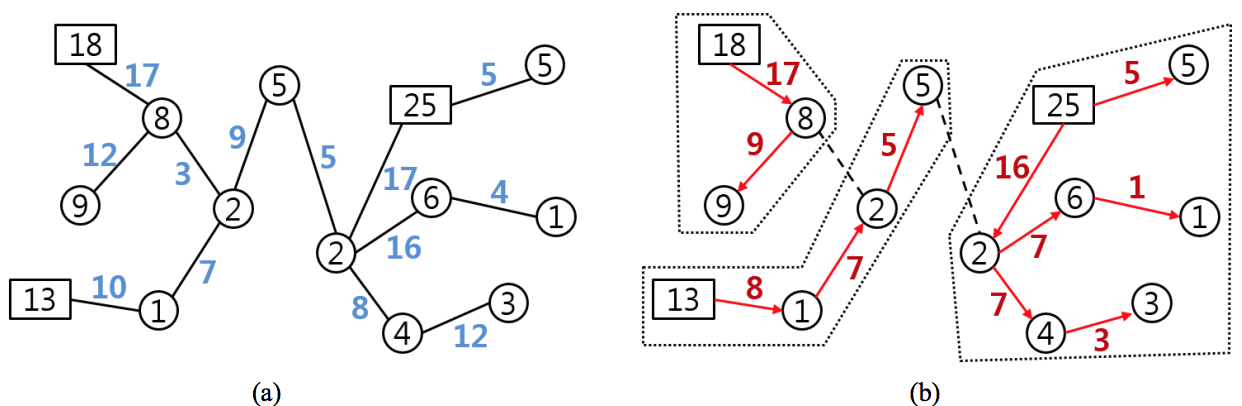
Figure 1. Illustration of a partition.
입력 형식
Your program is to read from standard input. The first line of the input contains one integer N to represent the number of vertices in the tree T (1 ≤ N ≤ 300,000). The vertices are represented by integers 1, 2, …, N. The i-th line of the next N lines contains two integers a and b, where if a = 0, then the vertex i is a supply vertex with the supply b, and if a = 1, then the vertex i is a demand vertex with the demand b (i = 1, … , N, a = 0 or 1, and 1 ≤ b ≤ 109). Also each of the next N − 1 lines contains three integers x, y, and z to represent one edge in T, joining two vertices x, y with the capacity z (1 ≤ x, y ≤ N, 1 ≤ z ≤ 109).
출력 형식
Your program is to write to standard output. Print either 0 or 1 in the line. If there is a desired partition from T, then print 1. Otherwise, print 0.
예제 입력 1
4
1 3
1 1
0 8
1 4
2 1 3
3 2 8
2 4 4
예제 출력 1
1예제 입력 2
4
1 3
1 1
0 8
1 4
2 1 3
3 2 7
2 4 4
예제 출력 2
0예제 입력 3
14
0 18
0 13
1 9
1 8
1 1
1 2
1 5
1 2
1 6
1 4
0 25
1 5
1 1
1 3
4 1 17
4 3 12
6 4 3
5 6 7
5 2 10
7 6 9
7 8 5
12 11 5
8 11 17
9 8 16
9 13 4
10 8 8
14 10 12
예제 출력 3
1
Comments