[BOJ 15209] Skiing
View as PDFAfter an unsuccessful attempt to qualify for IOI, Kleofáš decided to become a slalom skiing champion. Tomorrow is a very important day in Kleofáš's life: he will compete in his very first skiing contest!</p>
During the contest, Kleofáš will have to get from a starting point to a finishing point, while passing through $n$ gates. In order to be as fast as possible, Kleofáš wants to use the shortest possible trajectory.
A skiing course can be described as a starting point $S$, a finishing point $F$ and $n$ gates. Each gate is a line segment parallel to the $x$ axis (i. e. horizontal). No two gates are at the same $y$ coordinate (altitude). The starting point is above each gate i. e. its $y$ coordinate is higher than $y$ coordinate of any gate. The finishing point is below each gate and below the starting point.
Find the shortest polygonal chain starting at point $S$, finishing at point $F$ and intersecting all gates, in order from top to bottom. We say that a polygonal chain intersects a line segment if they have at least one common point (this point can be an endpoint of the line segment).
입력 형식
First line of the input contains one integer $n$ ($0 \leq n \leq 10^6$) -- number of gates. Second line contains four integers $x_S, y_S, x_F, y_F$: coordinates of points $S = (x_S, y_S)$ and $F = (x_F, y_F)$ respectively.</p>
$n$ lines follow, $i$-th of them contains three integers ${x_1}_i, {x_2}_i, {y}_i$, meaning that $i$-th gate is a segment from $({x_1}_i, y_i)$ to $({x_2}_i, y_i)$. For each $i$, ${x_1}_i < {x_2}_i$ holds.
All coordinates are between $-10^9$ and $10^9$, inclusive. Gates are ordered from top to bottom, i. e. $y_S > y_1 > y_2 > \dots > y_n > y_F$
출력 형식
It can be proven that there always exists a unique shortest polygonal chain and all its vertices have integer coordinates. Output this chain without any redundant vertices (i. e. only output vertices where the chain changes its direction).</p>

On the first line of the output print a single integer $k$ -- number of vertices in the optimal chain. Then print $k$ more lines, $i$-th of them containing two space-separated integers $x_i, y_i$ -- coordinates of the $i$-th vertex of the chain. Vertices must be named from the start of the chain to the end, thus $x_1 = x_S, y_1 = y_S, x_k = x_F, y_k = y_F$ and $y_1 > y_2 > \dots > y_k$ must hold.
예제 입력
4
5 10 6 0
0 4 7
7 10 6
5 8 4
2 5 1
예제 출력
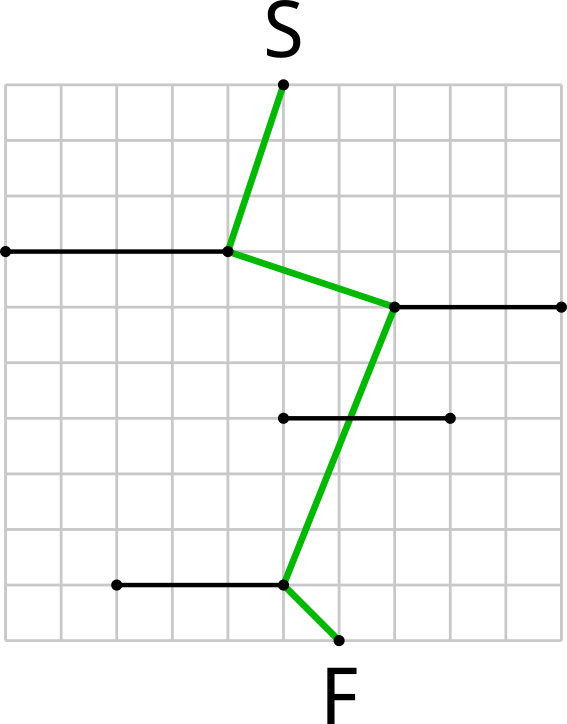
5
5 10
4 7
7 6
5 1
6 0
힌트
The situation looks like this:</p>
Comments