[BOJ 15302] Triangle to Hexagon
View as PDFGiven a triangle ABC with incenter (center of its inscribed circle), I, and circumscribed circle O, let M, N and P be the second points of intersection of the lines through A and I, B and I resp. C and I with the circle O.</p>
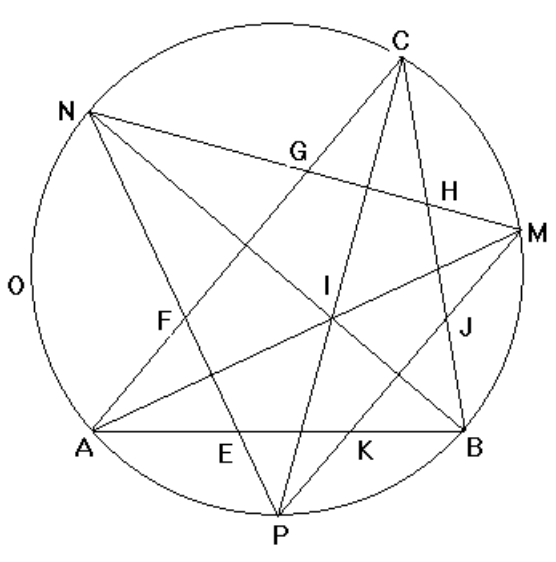
Let E and F be the intersections of the line NP with AB and AC respectively. Similarly, let G and H be the intersections of the line MN with AC and BC respectively and let J and K be the intersections of the line MP with BC and AB respectively.
Write a program which takes as input the coordinates of the vertices A, B and C of the triangle and outputs the lengths of the segments EF, FG, GH, HJ, JK and KE. Supposedly,
|EF| + |GH| + |JK| <= |KE| + |FG| + |HJ|.
Computations should be done in double precision floating point.
입력 형식
The first line of input contains a single integer P, (1 ≤ P ≤ 10000), which is the number of data sets that follow. Each data set should be processed identically and independently.</p>
Each data set consists of one line of input. The line contains the data set number, K, followed by three floating point values: the x coordinate of B, Bx, the x coordinate of C, Cx and the y coordinate of C, Cy. A will always be the origin (0,0) and B will always be on the x-axis so By = 0.
출력 형식
For each data set there is a single line of output. The single output line consists of the data set number, K followed by the 6 decimal values to 4 decimal places separated by spaces. The values are the lengths of EF, FG, GH, HJ, JK and KE in that order.
예제 입력
3
1 3 2.5 3
2 3 2 3
3 3 4 3
예제 출력
1 0.9992 1.5332 0.9954 0.9300 1.1859 0.9048
2 1.0450 1.3309 1.0257 1.0238 1.1358 0.9214
3 0.8499 2.2397 0.8447 0.8959 1.3790 0.8063
Comments