[BOJ 6060] Wheel Rotation
View as PDFFarmer John has an old-time thresher (wheat harvester) that requires belts to be installed on various gears to turn the parts. The engine drives pulley 1 in a clockwise direction which attaches via a belt to pulley 2. Pulley 2 attaches via a belt to pulley 3 and so on through a total of N (2 <= N <= 1,000) pulleys (and N-1 belts).</p>
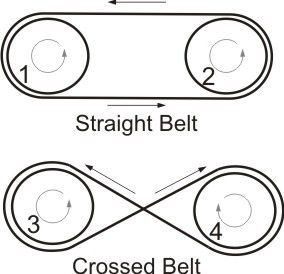
The diagram above depicts the two ways a belt can be installed between two gears. In this illustration, pulley 1's belt directly drives pulley 2 (a 'straight' connection) and thus they will rotate in the same direction. Pulley 3 drives pulley 4 via a 'crossed belt' that reverses the direction of the rotation.
Given a list of the belt types that connect the pulleys along with the fact that pulley 1 is driven in a clockwise direction by the engine, determine the drive direction of pulley N. Each belt is described by three integers:
- S_i -- the driving (source) pulley
- D_i -- the driven (destination) pulley
- C_i -- the connection type (0=straight, 1=crossed)
Unfortunately, FJ lists the belts in random order.
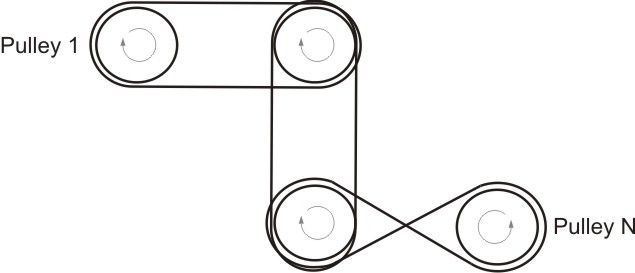
By way of example, consider the illustration below. N = 4, and pulley 1 is driven clockwise by the thresher engine. Straight belts drive pulley 2 and then pulley 3, so they rotate clockwise. The crosswise belt reverses the rotation direction so pulley 4 (pulley N) rotates counterclockwise.
입력 형식
- Line 1: A single integer: N
- Lines 2..N: Each line describes a belt with three integers: S_i, D_i, and C_i
출력 형식
- Line 1: A single integer that is the rotation direction for pulley N (0=clockwise, 1=counterclockwise)
예제 입력
4
2 3 0
3 4 1
1 2 0
예제 출력
1
Comments